

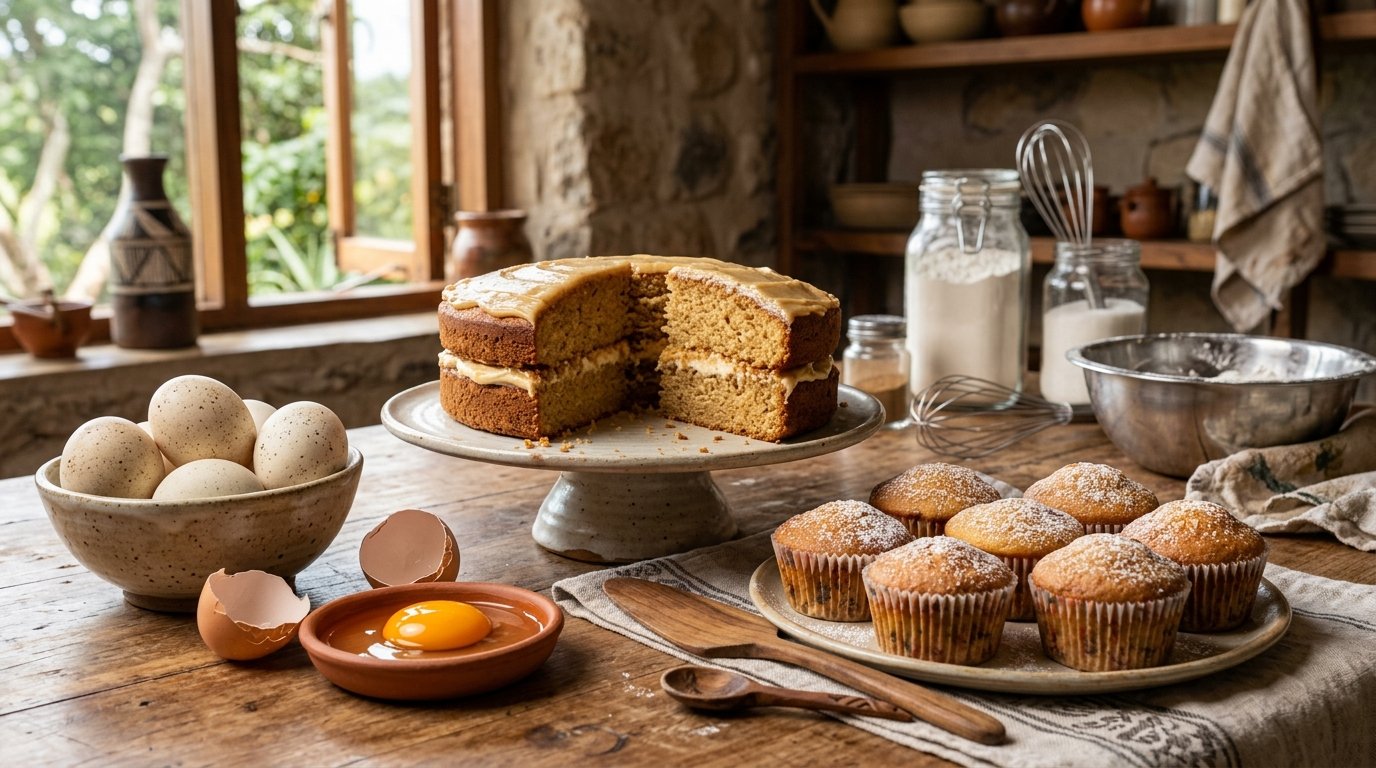
Yes—duck eggs are excellent for baking, and many bakers find they produce better results than chicken eggs.
If you’ve ever baked a cake that looked good but felt a bit dry or flat, the issue might not be your skill—it might be your ingredients. Eggs play a bigger role than most people think, and switching from chicken eggs to duck eggs can quietly transform your results.
Are duck eggs good for baking?
Yes, duck eggs are better for baking because they contain more fat and protein, which improves texture, moisture, and structure.
If you want softer cakes, richer flavour, and more consistent results, duck eggs are one of the simplest upgrades you can make.
Why do duck eggs work better in baking?
It comes down to what’s inside the egg. Duck eggs naturally have:
- More fat (especially in the yolk)
- More protein (in the whites)
- Larger yolks overall
This combination affects your baking in very practical ways:
Better structure
Your cakes hold together well without collapsing or becoming too dense.
Improved rise
The extra protein helps trap air more effectively, giving your cakes and pastries a better lift.
Richer texture
The higher fat content makes baked goods softer and more indulgent.
It’s not a complicated change—but it creates noticeably better results.
This is also why duck eggs are considered more nutrient-dense—explained further in our guide on Benefits of Duck Eggs.
Do duck eggs make cakes softer and more moist?
Yes, and this is because of their higher fat content, duck eggs:
- Keep cakes soft for longer
- Reduce dryness
- Improve overall mouthfeel
If you’ve ever baked a cake that felt dry even on the same day, duck eggs can fix that. For bakeries, this can be the difference between an average product and one customers come back for.
Do duck eggs change the taste of baked goods?
They do—but not in a bad way.
Duck eggs don’t make your baking taste “eggy.” Instead, they:
- Enhance the overall flavour
- Add a deeper, more satisfying taste
- Give baked goods a slightly richer profile
Most people won’t immediately know why your cake tastes better—they’ll just notice that it does.
How do duck eggs compare to chicken eggs in baking?
When you compare them side by side, the difference becomes clear.
Duck eggs tend to give you:
- Softer cakes
- Better rise
- More moisture
- Richer flavour
Chicken eggs give you:
- Standard, predictable results
- A lighter texture
- A more neutral taste
Chicken eggs still work—but duck eggs give you that “premium” finish.
If you want a full breakdown beyond baking, see Duck Eggs vs Chicken Eggs: Which Is Better?
Can you substitute duck eggs for chicken eggs in baking?
Yes—you can substitute them easily.
Because duck eggs are larger:
- 1 duck egg ≈ 1.5 chicken eggs
Simple guideline:
- Use fewer duck eggs than chicken eggs in most recipes
- Or keep the same number if you want a richer result
Most bakers adjust quickly after one or two tries.
What tips should you follow when baking with duck eggs?
If you’re trying duck eggs for the first time, these tips will help you get the best results:
1. Don’t overuse them at first
Start by replacing part of your eggs, then adjust once you see the results.
2. Mix properly
Because of the thicker whites and richer yolk, make sure your eggs are well incorporated into the batter.
3. Watch your baking time
Richer batters can sometimes bake slightly differently—keep an eye on doneness.
4. Use fresh eggs
Fresh duck eggs give the best flavour and consistency, especially for baking.
What happens when you actually try baking with duck eggs?
A good example of this came from Siaya.
We once gave a few duck eggs to Mary, a catering and hospitality instructor at Siaya Institute, just to try during a student demonstration day. There was no payment—just a simple test to see how they perform.
The students used the eggs in their baking, and the difference showed up immediately in the texture and overall quality.
Since then, she has continued using them and now regularly sources duck eggs for her classes.
That’s usually how it goes—once you try them and see the results for yourself, it stops being an experiment and becomes your new normal.
When should you use duck eggs for baking?
Duck eggs make the most sense if:
- You bake cakes, cupcakes, or pastries regularly
- You want softer, richer results
- You’re baking for biashara and want to stand out
- You care about consistency and quality
If you’re doing very basic baking, chicken eggs are still fine. But if you’re aiming for better results, duck eggs are worth it.
Where can you find duck eggs in Kenya?
Duck eggs are not as widely available as chicken eggs, but Nera Farm, among other farmers are rearing more and more of them, meaning the availability is steadily increasing, especially in places like Nairobi, Kisumu, and Siaya.
If you want to understand availability, pricing, and how to choose quality eggs, see Duck Eggs in Kenya (Benefits, Prices & Where to Buy).
Frequently asked questions
Do duck eggs make cakes better?
Yes, they improve texture, moisture, and overall richness.
Can I replace chicken eggs with duck eggs?
Yes—just use fewer since they are larger.
Do duck eggs change the taste of baking?
They enhance flavour, making baked goods richer.
Are duck eggs good for biashara baking?
Yes, especially if you want better quality and consistency.
Ready to Upgrade Your Baking?
If you’ve been baking with the same ingredients and getting average results, switching your eggs might be the simplest upgrade you can make.
Duck eggs can help you achieve softer cakes, better texture, and more consistent results—whether you’re baking at home or for biashara.
At Nera Farm, we supply fresh duck eggs directly from our farm in Siaya, with delivery options across Kenya. If you’d like to try them out, you can check availability and find the right quantity for your needs.